Crypto trading can look intimidating from the outside: flashing charts, unfamiliar jargon and prices that move around the clock. The good news is that the core ideas are learnable, and a beginner with a clear process can avoid most of the costly errors that catch newcomers. This Bithoex.com guide to crypto trading for beginners walks you through everything you need, from how orders work to how to protect your capital on your very first trade.
In this guide:
- What crypto trading is and how it differs from long-term investing
- How exchanges, order books and order types work
- Spot vs futures, candlestick charts and market cycles in plain English
- Risk management, position sizing and a worked example
- How to build a trading plan and journal, and how fees affect results
- Common mistakes, a 7-step first-trade checklist and answers to frequent questions
Risk reminder: Crypto assets are highly volatile and you can lose money. This guide is educational and is not financial advice.
What Is Crypto Trading?
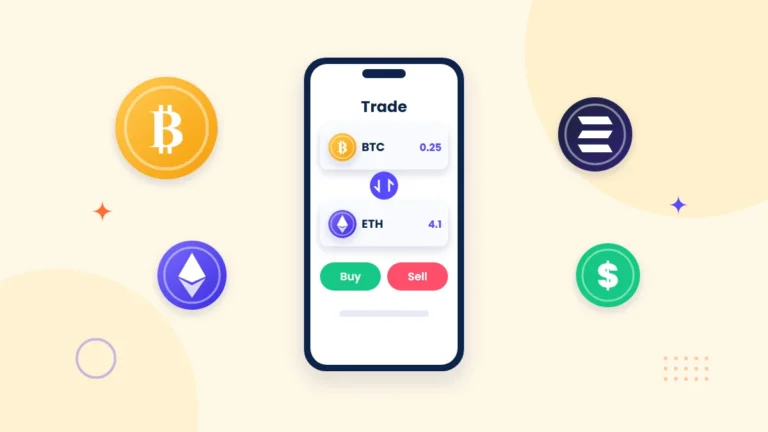
Crypto trading is the act of buying and selling digital assets such as Bitcoin or Ether with the aim of profiting from price changes. Unlike traditional stock markets, crypto markets run 24 hours a day, seven days a week, across exchanges worldwide.
Bitcoin was introduced in 2008 as a peer-to-peer electronic cash system, described in the original Bitcoin whitepaper. Thousands of other tokens have followed, including Ether, the native asset of the Ethereum network, which also supports smart contracts and decentralized applications.
Trading vs Investing
Both involve buying crypto, but the mindset and time frame are different:
- Investing usually means buying an asset you believe in and holding it for months or years, largely ignoring short-term swings.
- Trading means taking positions over shorter periods (minutes to weeks) based on a defined setup, with clear entry and exit rules.
- Many people do both, keeping a long-term core holding while trading a smaller, separate portion of their capital.
Common Trading Styles
- Day trading: opening and closing positions within the same day. Demanding and time-intensive.
- Swing trading: holding positions for days to weeks to capture a larger move. Often the most practical style for beginners with jobs.
- Position trading: holding for weeks to months based on bigger trends.
- Scalping: very short trades aiming for tiny gains many times a day. Not recommended for newcomers because fees and speed matter enormously.
If you want a step-by-step route from zero to your first trades, follow our beginner’s roadmap for starting crypto trading, which breaks the journey into manageable stages.
How Crypto Exchanges and Order Books Work
A centralized crypto exchange is a marketplace that matches buyers with sellers. When you deposit funds and place an order, the exchange’s matching engine pairs your order with someone else’s on the other side.
Trading Pairs
Every trade involves a pair, such as BTC/USDT. The first asset is the base (what you are buying or selling) and the second is the quote (what you are pricing it in). Buying BTC/USDT means spending USDT to receive BTC.
Reading the Order Book
The order book is a live list of every open buy and sell order for a pair:
- Bids are buy orders, listed from highest price down.
- Asks (or offers) are sell orders, listed from lowest price up.
- The spread is the gap between the highest bid and the lowest ask. Tight spreads usually signal an active, liquid market.
- Depth shows how much volume sits at each price level. Thin depth means large orders can move the price noticeably.
Liquidity and Slippage
Liquidity describes how easily you can buy or sell without shifting the price. Major pairs tend to be very liquid, while small tokens can be thin. When liquidity is low, a large market order may “walk the book” and fill at progressively worse prices. That difference between expected and actual price is called slippage.
Market vs Limit vs Stop Orders
Knowing which order type to use is one of the most practical skills in crypto trading for beginners. Each type trades off speed against price control.
| Order type | What it does | Best used when | Main drawback |
|---|---|---|---|
| Market | Buys or sells immediately at the best available price | Speed matters more than exact price | Possible slippage; usually pays taker fees |
| Limit | Buys or sells only at your chosen price or better | You want price control and can wait | May never fill if price does not reach your level |
| Stop-market | Triggers a market order once a stop price is hit | Cutting losses quickly | Can fill well below the stop in fast markets |
| Stop-limit | Triggers a limit order once a stop price is hit | Controlling exit price | May not fill if price gaps past your limit |
Market Orders
A market order says “fill me now.” It is simple and reliable for liquid pairs, but you accept whatever price the order book offers at that moment.
Limit Orders
A limit order sets the maximum you will pay (for a buy) or the minimum you will accept (for a sell). Limit orders that rest on the book add liquidity and are often charged a lower “maker” fee on many exchanges.
Stop Orders and Take-Profit Orders
Stop orders sit dormant until a trigger price is reached. Traders use a stop-loss to exit a losing position automatically and a take-profit order to lock in gains at a target. Some platforms also offer OCO (one-cancels-the-other) orders, which pair a stop-loss with a take-profit so that when one fills, the other is cancelled.
Spot vs Futures Trading
Most beginners start with spot trading, and for good reason. Here is the short version:
- Spot trading means buying or selling the actual asset for immediate settlement. If you buy one ETH on the spot market, you own one ETH.
- Futures trading uses contracts that track an asset’s price. You never hold the coin itself, and you can go long (bet on a rise) or short (bet on a fall).
- Leverage is common in futures. It magnifies both gains and losses and introduces liquidation, where your position is closed automatically if losses eat through your margin.
- Perpetual futures have no expiry date and use periodic funding payments between longs and shorts to keep the contract close to the spot price.
Because leverage can wipe out an account quickly, most educators suggest mastering spot trading before touching derivatives. For a full side-by-side breakdown, including margin, funding rates and liquidation math, read our guide to spot vs futures trading.
Reading Charts and Market Cycles
Charts show what price is doing right now, while market cycles explain the bigger backdrop. You need both to make sense of any single trade.
Candlestick Charts in Brief
Price charts are the trader’s map, and candlestick charts are the most popular format. Each candle summarizes price action over a chosen time frame, such as one hour or one day.
Anatomy of a candle:
- Open: the price at the start of the period.
- Close: the price at the end of the period.
- High and low: the extremes reached, shown by the thin lines called wicks or shadows.
- Body color: typically green (or white) when the close is above the open, and red (or black) when it is below.
What beginners should look for:
- Trend: a series of higher highs and higher lows (uptrend) or lower highs and lower lows (downtrend).
- Support and resistance: price zones where buying or selling has repeatedly appeared.
- Volume: moves on rising volume tend to be more meaningful than moves on thin volume.
- Multiple time frames: check the daily chart for context before zooming into shorter ones.
Patterns like dojis, hammers and engulfing candles can hint at shifts in momentum, but no pattern works every time. Learn the essentials, with visual examples, in our walkthrough on how to read candlestick charts.
Market Cycles and Sentiment
Crypto markets have historically moved in broad cycles of expansion and contraction. Understanding where the market might be in that cycle helps you set realistic expectations and avoid buying purely out of excitement.
The four phases:
- Accumulation: prices are flat after a decline, interest is low and patient buyers build positions.
- Markup: prices trend higher, media coverage grows and new participants arrive.
- Distribution: momentum fades, prices chop sideways near highs and early buyers take profits.
- Markdown: prices trend lower, fear spreads and many late buyers sell at a loss.
Sentiment is the collective mood of the market. Traders gauge it through sentiment indexes, funding rates on futures, social media activity and news flow. Extreme greed often appears near local tops, while extreme fear often appears near local bottoms, though timing these turns is never precise.
To go deeper on phases, indicators and the psychology behind them, see understanding crypto market cycles and sentiment, and browse our market analysis section for broader context.
Risk Management and Position Sizing
If there is one section of this guide to reread, it is this one. Professional traders focus first on how much they could lose, and only then on how much they could make.
Core Risk Rules
- Only trade money you can afford to lose. Keep emergency savings and essential funds completely separate.
- Risk a small, fixed percentage per trade. Many traders cap risk at 1% to 2% of their trading account on any single position.
- Always define your stop-loss before entering. Know exactly where your idea is proven wrong.
- Favor a positive risk-to-reward ratio. Aim for setups where the potential gain is at least 1.5 to 2 times the potential loss.
- Avoid leverage while learning. It amplifies mistakes faster than it amplifies skill.
A Simple Worked Example
Imagine you have a trading account of $2,000 and you follow a 1% risk rule. Here is how you would size a trade on a hypothetical token:
- Maximum risk: 1% of $2,000 = $20. This is the most you will lose if the trade fails.
- Entry price: you plan to buy at $50.
- Stop-loss: your analysis says the idea is invalid below $47.50, so you place your stop there.
- Risk per unit: $50 − $47.50 = $2.50.
- Position size: $20 ÷ $2.50 = 8 tokens, a position worth $400.
- Target: with a 2:1 reward-to-risk goal, your take-profit sits at $55, for a potential gain of about $40 before fees.
Notice that the position is $400, not $2,000. Position sizing lets you stay in the game after a losing streak. Even ten losses in a row at 1% each would leave roughly 90% of your account intact.
Protect the Account Itself
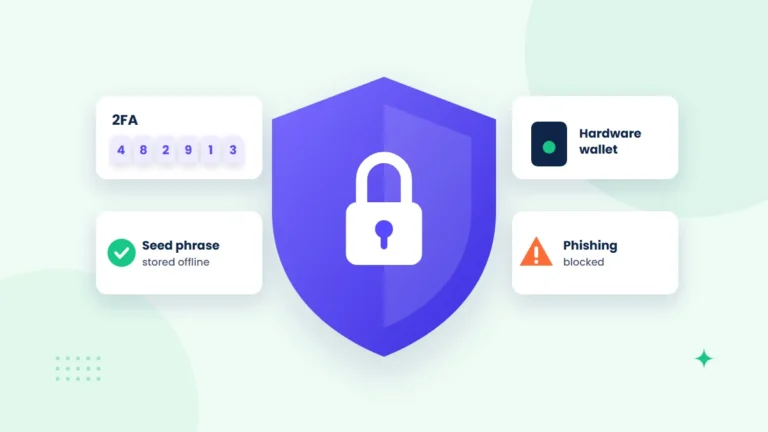
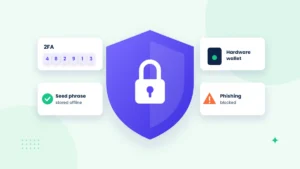
Risk management also covers security. Use strong unique passwords, enable two-factor authentication and watch for phishing. Our crypto security guide covers wallets, account protection and scam prevention in detail.
Building a Trading Plan, Journal and Fee Budget
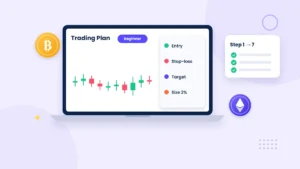
A trading plan turns vague intentions into rules you can follow when emotions run high. A journal shows you whether those rules actually work.
What to Include in Your Trading Plan
- Goals: what you want to learn or achieve, stated realistically.
- Markets: which pairs you will trade (a short list is better than many).
- Time frame and style: for example, swing trading on the 4-hour and daily charts.
- Entry criteria: the specific conditions that must be true before you buy.
- Exit rules: where your stop-loss and take-profit go, and when you will exit early.
- Risk limits: maximum risk per trade, per day and per week.
- Review schedule: when you will evaluate results, such as every Sunday.
How to Keep a Trading Journal
Record every trade, win or lose. A spreadsheet works fine. Useful columns include:
- Date, pair and direction
- Entry, stop-loss, target and exit prices
- Position size and fees paid
- The reason for the trade and a screenshot of the chart
- Your emotional state and whether you followed the plan
- Outcome and one lesson learned
After 20 to 30 trades, patterns emerge. You may discover that one setup consistently loses or that you break rules after a loss. That insight is worth more than any single profitable trade.
Understanding Trading Fees
Fees are easy to ignore on a single trade but can quietly erode returns over hundreds of trades. Always check the current fee schedule on any platform before you start.
Common fee types:
- Maker fees: charged when your order adds liquidity to the book, usually a resting limit order.
- Taker fees: charged when your order removes liquidity, such as a market order. Often slightly higher than maker fees.
- Spread costs: an indirect cost when you buy at the ask and sell at the bid.
- Deposit and withdrawal fees: may apply to fiat transfers or on-chain crypto withdrawals, which also involve network fees.
- Funding fees: paid or received periodically on perpetual futures positions.
Why fees matter: suppose a hypothetical exchange charges 0.1% per side. A round trip (buy plus sell) costs about 0.2% of the position. On the $400 position from our example, that is roughly $0.80. That sounds small, but a trader making five round trips a day would pay around 1% of position value daily in fees alone. Frequent trading needs a genuine edge just to break even.
Common Beginner Mistakes to Avoid
Most early losses come from a handful of predictable errors rather than bad luck. The most frequent include:
- Trading without a plan and making decisions on impulse.
- FOMO buying after a big green candle, often near a short-term top.
- Revenge trading to “win back” a loss, usually with bigger size.
- Skipping stop-losses or moving them further away as price drops.
- Over-leveraging before understanding liquidation.
- Overtrading, which multiplies fees and fatigue.
- Following hype from anonymous social media accounts without research.
- Neglecting security, such as reusing passwords or clicking phishing links.
Each of these has a practical fix. Read 10 common crypto trading mistakes and how to avoid them for the full list with solutions.
Learn the Language First
Many mistakes start with misunderstood terms. If words like “slippage,” “liquidation” or “market cap” still feel fuzzy, keep our crypto glossary for beginners open while you learn. The SEC’s investor education site also offers a helpful overview of crypto asset risks worth reading before you commit funds.
Your First Trade: A 7-Step Checklist
Ready to put the theory into practice? Work through these steps in order, and keep your first position small.
- Secure your account. Choose a reputable platform, such as Bithoex.com, set a strong unique password and enable two-factor authentication.
- Fund a dedicated trading balance. Deposit only an amount you can afford to lose, kept separate from long-term holdings.
- Pick one liquid pair. Start with a major pair that has tight spreads and deep order books.
- Write down your setup. Note your reason for entering, your entry price, stop-loss and take-profit before placing anything.
- Size the position. Use the 1% rule and the formula: risk amount ÷ (entry − stop) = position size.
- Place your orders. Use a limit order to enter if possible, then immediately set your stop-loss and take-profit.
- Journal and review. Log the trade, let your orders do their job and review the outcome without second-guessing mid-trade.
| Before the trade | After the trade |
|---|---|
| Security settings checked | Trade logged in journal |
| Entry, stop and target written down | Fees recorded |
| Position size calculated | Plan followed? Yes or no |
| Risk at or below 1% to 2% | One lesson noted |
Once you are comfortable with the basics of spot trading, our guide to buying, selling and trading Bitcoin and altcoins covers asset selection and practical execution in more depth. You can also explore every article in our crypto trading category.
Frequently Asked Questions
How much money do I need to start crypto trading?
There is no universal minimum, and many exchanges let you trade small amounts. What matters more is starting with money you can afford to lose and keeping positions small while you learn. A modest balance lets you practice risk management without serious financial pressure.
Is crypto trading good for beginners?
It can be, provided beginners treat it as a skill to develop rather than a shortcut to quick profits. Starting with spot trading, avoiding leverage, using stop-losses and keeping a journal makes the learning curve far safer. Expect to make mistakes early, and keep them small.
What is the safest order type for a beginner?
Limit orders give you the most price control and help you avoid slippage, while stop-loss orders protect you from large losses. Using both together, or an OCO order where available, is a sensible default for new traders.
Are crypto assets regulated like stocks?
Regulation varies by country and by asset, and it continues to evolve. In the United States, some crypto assets may be treated as securities; the SEC explains this through the concept of crypto asset securities on its investor education site. Always check the rules that apply where you live.
Final Thoughts
Crypto trading for beginners is less about predicting the next big move and more about building a repeatable process. Understand how orders and order books work, start with spot markets, read charts with context and respect market cycles. Above all, size every position so that no single trade can seriously damage your account.
Write a plan, keep a journal and review your results honestly. Progress comes from small, consistent improvements rather than lucky wins. When you feel prepared, you can trade crypto on Bithoex.com with a clear checklist in hand.
Remember: crypto is volatile, past performance does not guarantee future results and nothing here is financial advice. Trade carefully and keep learning.