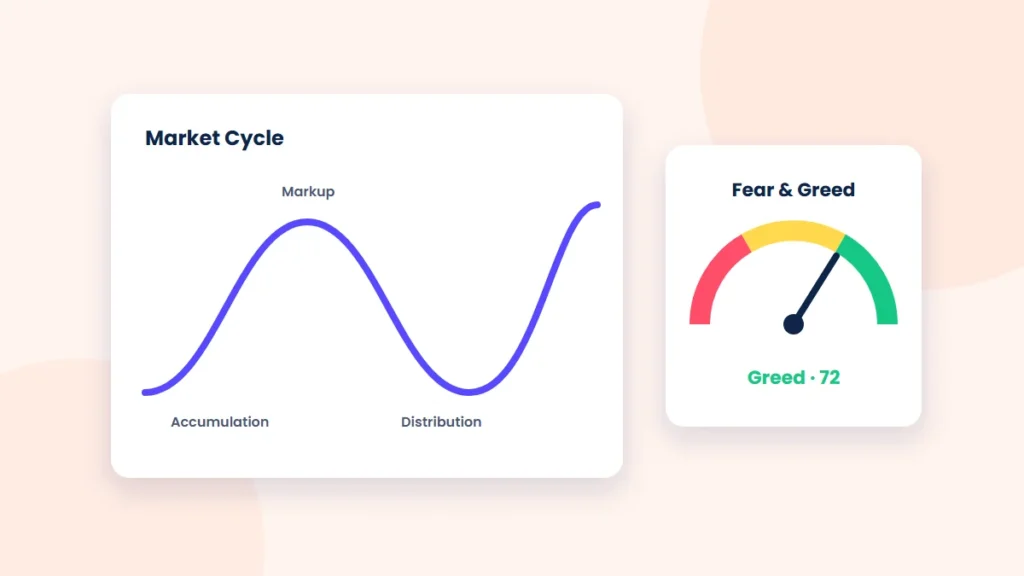
Crypto markets rarely move in a straight line. They tend to swing through recognizable phases of optimism, euphoria, fear and recovery, driven as much by human emotion as by fundamentals. Understanding these market cycles and the sentiment behind them can help you make calmer, more deliberate decisions instead of reacting to every headline.
What Is a Market Cycle?
A market cycle is the recurring pattern of rising and falling prices that markets move through over time. Every asset class experiences cycles, but in crypto they are often faster and more dramatic.
Cycles are shaped by a mix of factors, including liquidity, adoption, technology developments, regulation and, above all, investor psychology. No two cycles are identical in length or magnitude, but the emotional patterns behind them tend to rhyme.
The goal is not to predict exact tops and bottoms, which is nearly impossible. It is to recognize the general environment you are in and adjust your behavior accordingly. If you are new to trading, our beginner’s guide to crypto trading covers the fundamentals first.
Bitcoin’s Role in Crypto Cycles
Bitcoin is the largest and most established crypto asset, so its trend often sets the tone for the wider market. When Bitcoin rallies or falls sharply, many altcoins tend to follow, often with even bigger swings in both directions.
For that reason, many traders watch Bitcoin’s price structure and its share of total market value, known as Bitcoin dominance, as a rough guide to overall risk appetite. You can learn more in our Bitcoin guides.
The Four Phases of a Crypto Market Cycle
Analysts often describe market cycles in four broad phases, a framework popularized by Richard Wyckoff’s work on market structure.
1. Accumulation
After a long decline, prices move sideways in a range. Sentiment is gloomy, media coverage fades and many retail traders have left. Patient, long-term buyers quietly accumulate positions while others have lost interest.
2. Markup
Price breaks out of the range and begins forming higher highs and higher lows. Early on, skepticism remains. As gains continue, confidence grows, new participants arrive and momentum builds. Late in this phase, excitement can turn into euphoria.
3. Distribution
Price stalls at elevated levels and starts moving choppily. Early buyers take profits while late arrivals keep buying, hoping for more upside. Volatility often increases, and sentiment is mixed between optimism and nervousness.
4. Markdown
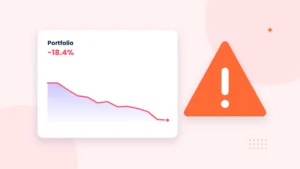
Selling pressure takes over and price forms lower highs and lower lows. Denial gives way to fear and, eventually, capitulation, when many holders sell in frustration. This often sets the stage for the next accumulation phase.
The Psychology Behind the Cycle
Market cycles are ultimately a reflection of collective human emotion. The well-known “cycle of market emotions” maps how sentiment tends to evolve:
- Optimism and excitement as prices begin to rise.
- Thrill and euphoria near the top, when risk feels lowest but is often highest.
- Anxiety and denial as the first meaningful drops appear.
- Fear and panic during sharp declines.
- Capitulation and despondency near the bottom, when many give up entirely.
- Hope and relief as the market stabilizes and starts recovering.
The point of maximum financial opportunity often feels like the point of maximum discomfort, and the reverse is also true.
Two emotions in particular drive poor decisions. FOMO (fear of missing out) pushes people to buy after big rallies, while FUD (fear, uncertainty and doubt) pushes them to sell after big drops. Both feature among the most common crypto trading mistakes.
How to Measure Market Sentiment
Sentiment cannot be measured perfectly, but several tools can give you a useful read on the mood of the market.
| Indicator | What It Tracks | How Traders Use It |
|---|---|---|
| Fear and Greed Index | A composite of volatility, momentum, social data and more | Extreme readings can flag overheated or oversold conditions |
| Funding rates | Payments between long and short traders in perpetual futures | Very high positive rates can signal crowded, overleveraged longs |
| Open interest | The total value of open derivatives contracts | Rapid growth can indicate rising leverage and fragility |
| Social and search trends | Mentions, search volume and online buzz | Mainstream hype often appears late in a rally |
| On-chain data | Wallet activity, exchange flows and holder behavior | Shows whether long-term holders are accumulating or distributing |
Use Sentiment as a Contrarian Lens
Many experienced traders treat extreme sentiment as a warning sign rather than a confirmation. When everyone is euphoric, much of the good news may already be priced in. When fear is at its peak, sellers may be close to exhausted.
That said, sentiment can stay extreme for longer than expected. Use it as one input alongside price structure, volume and your own risk plan, never as a standalone trigger.
Practical Strategies for Each Phase
You do not need to time the market perfectly to benefit from understanding cycles. A few principles can help across all phases:
During Accumulation and Early Markup
- Consider dollar-cost averaging (DCA) to build positions gradually without trying to pick the exact bottom.
- Focus on research and fundamentals while the market is quiet.
- Be patient, since sideways markets can last a long time.
During Late Markup and Distribution
- Set predefined profit-taking targets and stick to them.
- Be cautious with leverage as volatility increases.
- Rebalance your portfolio if a single asset has grown far beyond your intended allocation.
During Markdown
- Protect capital with stop-losses and sensible position sizes.
- Avoid panic selling based on headlines alone.
- Keep a watchlist and a plan ready for when conditions improve.
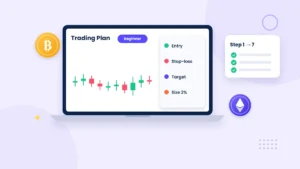
When trading on a platform like Bithoex.com, deciding on your entries, exits and position sizes before you place any order can help you follow your plan instead of your emotions. You can find more strategy ideas in our crypto trading guides.
Remember that crypto is highly volatile, past cycles do not guarantee future patterns and this article is not financial advice. For a regulator’s view of the risks, see the Investor.gov crypto assets spotlight.
Frequently Asked Questions
How long does a crypto market cycle last?
There is no fixed length. Historically, many observers have linked broad crypto cycles to Bitcoin’s halving schedule, roughly every four years, but cycles are influenced by many factors and can be shorter, longer or less clear than in the past.
Can sentiment indicators predict price?
No indicator predicts price reliably. Sentiment tools are best used to understand the current mood of the market and to spot extremes, which can help you manage risk and avoid emotional decisions.
What is the biggest mistake traders make during cycles?
Buying heavily during euphoria and selling in panic during fear. Having a written plan with entry, exit and position-size rules is one of the best defenses against this pattern.
Final Thoughts
Market cycles and sentiment are two sides of the same coin: prices move in phases because people’s emotions move in phases. By learning to recognize where the market may be in its cycle and how the crowd is feeling, you can step back from the noise and trade with more discipline. Bithoex.com users who pair that awareness with a clear risk plan will be better prepared for whatever the next phase brings.