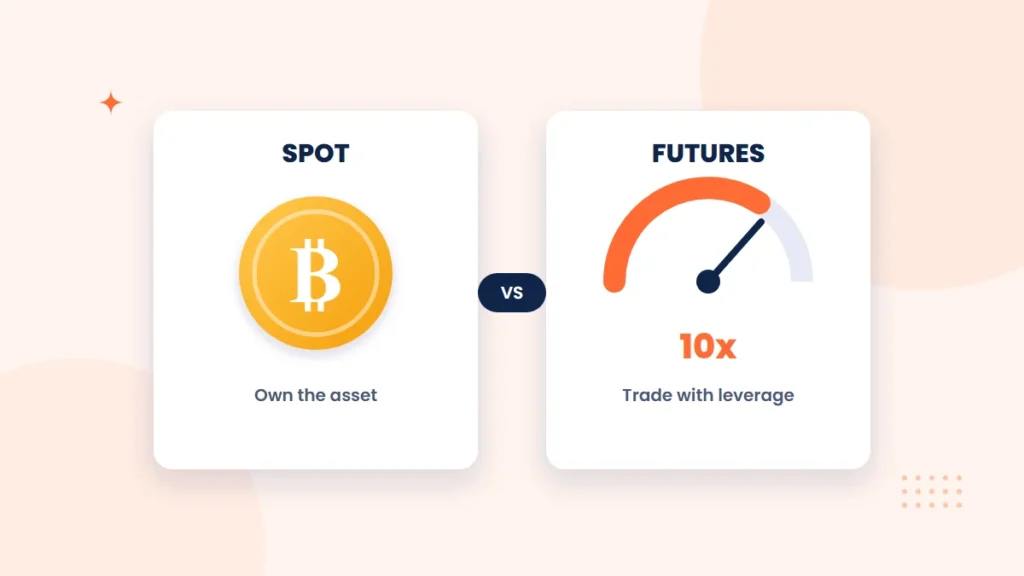
Spot and futures trading are two of the most common ways to trade crypto, but they work very differently. One lets you own the actual coins, while the other lets you speculate on price without holding the asset at all. Understanding the difference will help you pick the approach that matches your goals, experience and tolerance for risk.
What Is Spot Trading?
Spot trading is the simplest form of crypto trading. You buy or sell a digital asset at the current market price, and the trade settles “on the spot.” When you buy Bitcoin on the spot market, that Bitcoin is yours.
Key features of spot trading include:
- Direct ownership: You hold the real asset and can withdraw it to your own wallet.
- Simple profit and loss: You profit if the price rises above your purchase price and lose if it falls.
- No liquidation risk: Without leverage, your position can’t be forcibly closed. The most you can lose is what you put in.
- No expiry: You can hold as long as you like.
Who Spot Trading Suits Best
Spot trading is a natural starting point for beginners, long-term holders and anyone who wants to use their crypto, for example by moving it into DeFi apps or cold storage. It is also easier to track and generally less stressful. Our Crypto Trading for Beginners guide covers those first steps in detail.
What Is Futures Trading?
A futures contract is an agreement to buy or sell an asset at a set price at a later date. In crypto, many traders use perpetual futures, which have no expiry date and track the spot price through a mechanism called the funding rate.
With futures, you never own the underlying coin. Instead, you hold a contract whose value moves with the asset’s price. This opens up some powerful options:
- Going long: Profiting if the price rises.
- Going short: Profiting if the price falls, which is difficult to do on the spot market.
- Leverage: Controlling a larger position with a smaller amount of capital, called margin.
- Hedging: Offsetting potential losses on spot holdings by opening an opposite futures position.
How Leverage Works
Leverage multiplies your exposure. With 5x leverage, a $200 margin controls a $1,000 position. A 10% price move in your favor would earn about $100, a 50% return on your margin.
The same math works against you. A 10% move against that position would lose about $100. Larger moves, or higher leverage, can trigger liquidation, where the exchange automatically closes your position and you lose your margin. The Investor.gov spotlight on crypto assets highlights similar risks.
Spot vs Futures: Side-by-Side Comparison
Here is a quick overview of how the two approaches compare:
| Feature | Spot Trading | Futures Trading |
|---|---|---|
| Asset ownership | Yes, you own the coins | No, you hold a contract |
| Profit from falling prices | Not directly | Yes, by shorting |
| Leverage | Typically none | Commonly available |
| Liquidation risk | None without leverage | Yes, if margin runs low |
| Ongoing costs | Trading fees | Trading fees plus funding payments |
| Complexity | Beginner-friendly | Intermediate to advanced |
| Best for | Holding, investing, learning | Active trading, hedging, shorting |
The Real Risks of Futures Trading
Futures can be valuable tools, but they demand respect. Many new traders underestimate how quickly a leveraged position can unravel in a volatile market. Misusing leverage is one of the most common crypto trading mistakes.
- Liquidation: If losses eat through your margin, your position is closed automatically, often at the worst moment.
- Funding rates: On perpetual contracts, longs and shorts pay each other periodically. Holding a position for weeks can quietly add up in costs.
- Emotional pressure: Amplified gains and losses make it harder to stick to a plan.
- Sudden wicks: Brief, sharp price spikes can hit liquidation levels even if the price quickly recovers. Learning how to read candlestick charts helps you spot them.
Crypto markets are volatile, and leverage magnifies that volatility. This article is educational only and not financial advice.
Margin Modes to Know
- Isolated margin: Risk is limited to the margin assigned to one position.
- Cross margin: Your entire futures balance supports open positions, which can delay liquidation but puts more of your funds at risk.
Beginners who experiment with futures usually do better with isolated margin and low leverage.
How to Choose the Right Approach for Your Strategy
There is no single “better” option. The right choice depends on what you want to achieve. Ask yourself a few honest questions:
- What is my time horizon? Long-term goals align naturally with spot. Short-term, tactical trades may benefit from futures.
- Do I want to own the asset? If you plan to self-custody, stake or use your coins, you need spot.
- Do I need to short or hedge? Futures make it possible to profit from declines or protect existing holdings.
- How much risk can I handle? If a sudden liquidation would be devastating, stick with spot.
- How experienced am I? Futures require a solid grasp of risk management, position sizing and market structure.
Combining Both
Many experienced traders use both. A common approach is to hold a core spot portfolio for the long term and use small, carefully sized futures positions to hedge during uncertain periods. This lets them keep ownership while managing short-term risk.
Practical Tips for Getting Started
Whichever route you choose, a few habits will serve you well:
- Start with spot trading to learn how markets move before adding leverage.
- If you try futures, begin with very small positions and low leverage.
- Always set a stop-loss and know your liquidation price before entering.
- Track funding rates if you hold perpetual positions for more than a short time.
- Keep a trading journal to review what works and what doesn’t.
On a platform like Bithoex.com, you can focus on buying, selling and trading crypto in a secure, straightforward environment while you build these skills. Always check which products are available to you and read the platform’s own documentation before trading.
Want to sharpen your approach further? Explore more strategy guides in our crypto trading section.
Frequently Asked Questions
Is futures trading riskier than spot trading?
Generally, yes. Spot trading without leverage limits your loss to the amount you invested. Futures with leverage can magnify losses and lead to liquidation, where you lose your entire margin on a position.
Can beginners trade crypto futures?
They can, but it is wise to gain experience on the spot market first. If you do try futures, use low leverage, isolated margin and strict stop-losses, and only risk money you can afford to lose.
What is a perpetual futures contract?
A perpetual futures contract is a futures contract with no expiry date. It stays close to the spot price through regular funding payments exchanged between traders holding long and short positions.
Final Thoughts
Spot trading offers simplicity and true ownership, while futures offer flexibility, shorting and leverage at the cost of higher risk. Most traders benefit from mastering spot first, then adding futures only when they fully understand the mechanics. Bithoex.com users who build that foundation will be better prepared to choose the right tool for every market condition.